Self-Employment Tax 2026: Rules, Rates, and Limits
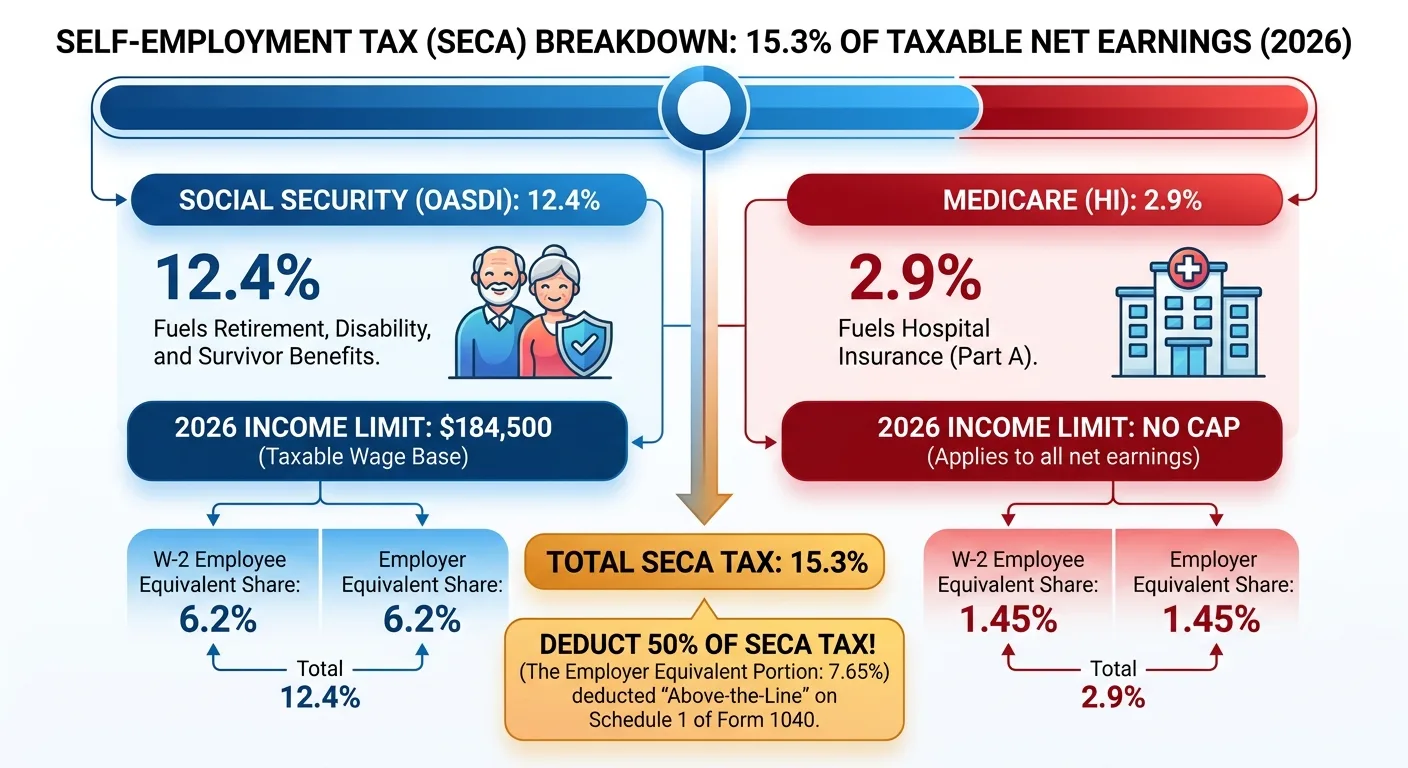
Self-employed individuals pay the full 15.3% Self-Employed Contributions Act (SECA) tax to fund Social Security and Medicare in 2026, according to the Internal Revenue Service (IRS) and the Social Security Administration (SSA). Understanding how Schedule SE calculates net taxable earnings and applies annual wage caps ensures accurate tax reporting while protecting your future retirement benefits.
Quick Answer: In 2026, self-employment tax is 15.3% on 92.35% of your net business earnings. This consists of 12.4% for Social Security (capped at $184,500 in earnings) and 2.9% for Medicare (uncapped). You can deduct the 7.65% "employer" equivalent share on Schedule 1 of your Form 1040.
How Self-Employment Tax Works in 2026
Traditional W-2 employees split Federal Insurance Contributions Act (FICA) taxes evenly with their employers, each paying 7.65%. Self-employed workers—sole proprietors, partners, gig workers, and independent contractors—pay the combined total under SECA, according to the Internal Revenue Service (IRS) and Social Security Administration (SSA).
The total 15.3% rate applies to net self-employment income over $400 in a tax year. However, the IRS applies a net earnings factor before applying the tax rate to mirror the employer tax exclusion available to traditional businesses.
| Tax Component | W-2 Employee Share | Employer Share | Self-Employed (SECA) Rate | 2026 Income Limit |
|---|---|---|---|---|
| Social Security (OASDI) | 6.2% | 6.2% | 12.4% | $184,500 |
| Medicare (HI) | 1.45% | 1.45% | 2.9% | No Limit |
| Total Base Rate | 7.65% | 7.65% | 15.3% | — |
Source: Internal Revenue Service (IRS)
Step-by-Step Schedule SE Tax Calculation
Self-employment tax is calculated on Schedule SE (Form 1040) using a specific three-step sequence according to IRS guidelines.
- Determine Net Business Income: Calculate gross business revenues minus allowable business expenses on Schedule C, Schedule F, or Schedule K-1.
- Apply the 92.35% Multiplier: Multiply net profit by 0.9235 to derive taxable net self-employment earnings. This step reduces taxable earnings by 7.65%, ensuring you do not pay tax on the employer portion of the tax itself.
- Apply Component Rates and Caps: Multiply net self-employment earnings up to $184,500 by 12.4% for Social Security. Multiply all net self-employment earnings by 2.9% for Medicare.
Worked Example: $100,000 Net Business Profit in 2026
- Gross Schedule C Net Profit: $100,000
- Taxable Net Earnings (Step 2): $100,000 × 0.9235 = $92,350
- Social Security Tax (12.4%): $92,350 × 0.124 = $11,451.40
- Medicare Tax (2.9%): $92,350 × 0.029 = $2,678.15
- Total 2026 SECA Tax: $11,451.40 + $2,678.15 = $14,129.55
- Above-the-Line Tax Deduction: $14,129.55 ÷ 2 = $7,064.78 (deducted on Schedule 1)
While standard calculations apply to standalone self-employment income, exact tax burdens vary significantly when combined with W-2 earnings or high-income Medicare thresholds. To estimate your tax obligations and net earnings accurately, use our Tax Calculator.
The 2026 Wage Base Cap and High-Income Surtaxes
Social Security tax applies only to earnings up to the annual maximum taxable wage base. In 2026, the maximum taxable earnings limit is $184,500, an increase from $176,100 in 2025, according to the Social Security Administration (SSA).
If you have both a W-2 job and self-employment income in 2026, W-2 wages credit toward the $184,500 Social Security cap first. Self-employment income is subject to the 12.4% Social Security tax only to the extent that W-2 earnings fall below $184,500.
An Additional Medicare Tax of 0.9% applies to self-employment income exceeding single filing thresholds of $200,000 ($250,000 for married filing jointly or $125,000 for married filing separately). Unlike the standard 2.9% Medicare tax, the 0.9% Additional Medicare Surtax cannot be reduced by the half-SECA deduction.
How Self-Employment Earnings Build Social Security Credits
Paying self-employment tax directly builds your work record with the Social Security Administration (SSA). In 2026, workers earn one Social Security credit (quarter of coverage) for every $1,890 of net self-employment earnings, up to the annual maximum of four credits ($7,560 total earnings).
Accumulating 40 credits (10 years of work) is required to qualify for retirement benefits. Your actual monthly Primary Insurance Amount (PIA) is calculated using your highest 35 years of indexed earnings. Underreporting self-employment earnings reduces your official earnings record, which permanently lowers future Social Security retirement, SSDI, and survivor benefits.
Frequently Asked Questions
How do I deduct the employer half of self-employment tax?
You can deduct 50% of your calculated self-employment tax as an above-the-line adjustment to gross income on Schedule 1 (Form 1040). This deduction lowers your Adjusted Gross Income (AGI) and income tax liability regardless of whether you claim the standard deduction or itemize.
Do I pay self-employment tax if my net earnings are under $400?
No, self-employment tax is not owed if your net earnings from self-employment are less than $400 in a tax year, according to the Internal Revenue Service (IRS). However, you must still file an income tax return if you meet other filing requirements.
How do W-2 wages affect the self-employment tax maximum cap?
W-2 wages count first toward the annual $184,500 Social Security wage base cap in 2026. If your W-2 wages reach or exceed $184,500, your self-employment income is completely exempt from the 12.4% Social Security tax, though it remains subject to the 2.9% Medicare tax.
This article is for educational purposes only and does not constitute personalized financial, legal, or tax advice. SSA Guide Calc is an independent platform and is not affiliated with or endorsed by the Social Security Administration. For guidance specific to your situation, consult SSA.gov, Medicare.gov, or a licensed financial advisor.