Social Security Earnings Test Limit: How Working in Retirement Affects Your Benefits
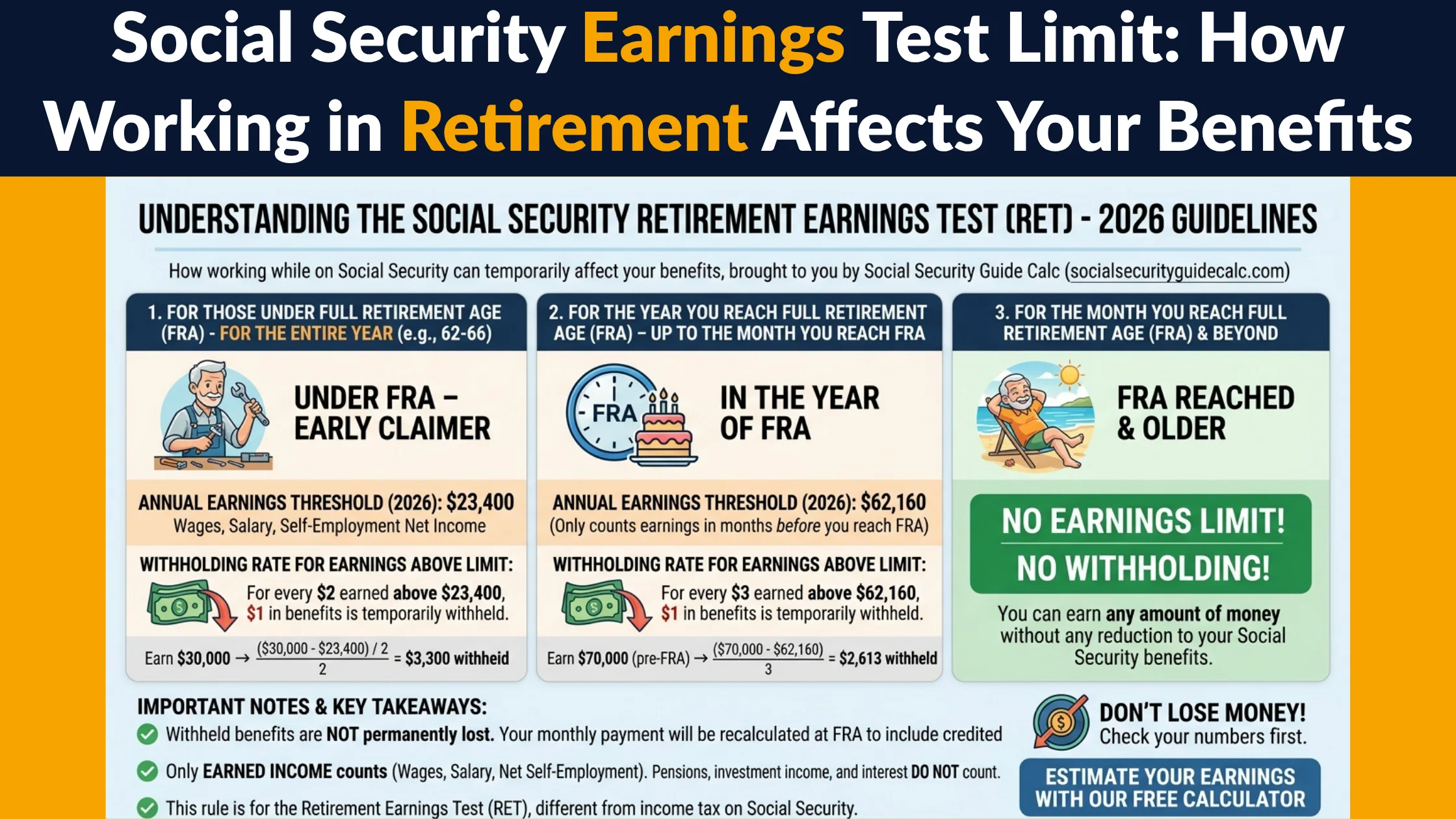
The Social Security earnings test limit is the maximum amount of earned income you can make while receiving Social Security retirement benefits before reaching your Full Retirement Age (FRA) without having a portion of your monthly benefit payments temporarily withheld.
Quick Answer
If you claim Social Security early and continue to work, the Social Security Administration (SSA) temporarily withholds $1 in benefits for every $2 earned above the annual exempt limit. In the calendar year you reach Full Retirement Age, a higher limit applies, withholding $1 for every $3 over the threshold. Once you hit your FRA, the earnings test ends completely, and SSA recalculates your benefit upward to account for withheld payments.
What Is the Social Security Retirement Earnings Test?
The Retirement Earnings Test (RET) is a federal provision applied by the Social Security Administration (SSA) to beneficiaries who collect retirement, spousal, or survivor benefits prior to reaching their statutory Full Retirement Age while continuing to receive earned income from employment or self-employment.
The purpose of the rule is to restrict Social Security benefits to individuals who have fully or partially retired from the active workforce. It does not apply to passive income such as investment dividends, pensions, capital gains, or 401(k) distributions.
Social Security Earnings Test Thresholds and Rules
The SSA categorizes working beneficiaries into two distinct rule phases depending on their age relative to their Full Retirement Age during the calendar year:
| Age Phase | Earnings Condition | Withholding Rate |
|---|---|---|
| Under Full Retirement Age for the Entire Year | Earned income exceeds annual limit | $1 withheld for every $2 earned above threshold |
| Year Reaching Full Retirement Age | Earned income prior to birthday month exceeds higher limit | $1 withheld for every $3 earned above threshold |
| Month Hitting Full Retirement Age & Older | No earnings cap | No benefits withheld, regardless of total wages |
Source: Social Security Administration (SSA.gov)
What Counts as Earned Income Under the Earnings Test?
The SSA strictly distinguishes between active labor compensation and passive financial receipts when auditing income against the annual exempt limits.
Income subject to the earnings test includes:
- Gross wages from traditional employment (W-2 wages)
- Net earnings from self-employment (Schedule C income)
- Commissions, bonuses, and severance pay earned during the benefit year
Income excluded from the earnings test includes:
- Investment returns (stock dividends, capital gains, interest)
- Distributions from traditional or Roth IRAs, 401(k)s, and private pensions
- Annuity payouts, disability benefits, and inheritance proceeds
- Unemployment compensation and Workers' Compensation payments
Hypothetical Calculation Example: How Benefits Are Withheld
Consider a worker who turned 62 in 2026 and opted to start receiving a monthly Social Security benefit of $1,500 ($18,000 annually). They decide to remain employed in a consulting role earning $30,000 gross wages annually.
Assuming an annual exempt threshold of $23,400 for early claimers:
- Excess Earnings Calculation: $30,000 total wages – $23,400 exempt limit = $6,600 excess earnings.
- Withholding Penalty Applied: $1 withheld for every $2 over the threshold ($6,600 / 2 = $3,300 total reduction required).
- Monthly Benefit Adjustment: Rather than reducing monthly checks fractionally, the SSA withholds full monthly checks until the mandatory offset amount is covered. With a $1,500 monthly benefit, SSA withholds 3 full checks ($4,500 total withheld), leaving a remaining $1,200 balance paid back to the beneficiary in the following calendar year.
To determine how your exact wage profile, claiming age, and projected earnings impact your monthly benefit check, evaluate your numbers with our free earnings test calculator.
Do You Permanently Lose Withheld Social Security Benefits?
Benefits withheld under the Retirement Earnings Test are not permanently lost. When you reach your Full Retirement Age, the SSA automatically recalculates your primary insurance amount to credit back all full monthly benefits that were withheld due to your employment income.
For example, if you claimed benefits 36 months before your FRA and had 12 full monthly payments withheld due to work income, your permanent benefit amount at FRA will be adjusted as though you claimed 24 months early rather than 36 months early. This structural adjustment increases your ongoing monthly check for the rest of your life.
Frequently Asked Questions About the Social Security Earnings Test Limit
Does the Social Security earnings test apply after Full Retirement Age?
No, the Social Security earnings test stops completely starting the exact month you achieve your Full Retirement Age. From that month forward, you can earn an unlimited amount from wages or self-employment without any withholding applied to your monthly benefits.
Are Social Security benefits taxable if you continue to work?
Yes, working while collecting Social Security can cause a portion of your benefits to become subject to federal income tax. If your combined income (adjusted gross income + non-taxable interest + half of your Social Security benefits) exceeds $25,000 for single filers or $32,000 for married couples filing jointly, up to 85% of your benefits may be taxed.
How does SSA know if you earn more than the limit?
The SSA tracks earnings using W-2 forms submitted by employers and tax returns submitted to the IRS. Additionally, beneficiaries are legally required to report projected wage increases directly to the SSA to prevent overpayments that must be repaid later.
Does the earnings limit apply to SSDI or SSI payments?
Social Security Disability Insurance (SSDI) and Supplemental Security Income (SSI) do not use the Retirement Earnings Test, but they have separate Substantial Gainful Activity (SGA) limits and income thresholds that strictly regulate work eligibility.
*This article is for educational purposes only and does not constitute personalized financial, legal, or tax advice. SSA Guide Calc is an independent platform and is not affiliated with or endorsed by the Social Security Administration. For guidance specific to your situation, consult SSA.gov, Medicare.gov, or a licensed financial advisor.*