Social Security Early Retirement Penalty: The Hidden Cost of Filing at 62

Filing for Social Security at 62 feels like a win — money in your pocket years before full retirement age. But that early start comes with a permanent trade-off that many retirees underestimate. Understanding the exact size of that trade-off before you file is the difference between a confident retirement and a costly surprise.
What Is the Social Security Early Retirement Penalty?
The Social Security early retirement penalty is a permanent reduction applied to your monthly check if you claim before your Full Retirement Age (FRA). Claiming at age 62 reduces your benefit by up to 30% for life if your FRA is 67.
For most people today, FRA is 67. This reduction isn't a temporary deduction; it resets your monthly benefit permanently to a lower baseline, which then grows only through annual Cost-of-Living Adjustments (COLA) — never returning to the full amount you would have received at FRA.
How the Penalty Is Calculated: The SSA Formula
The Social Security Administration reduces your Primary Insurance Amount (PIA) using a month-by-month formula, not a flat percentage per year:
- For the first 36 months you claim early, your benefit is reduced by 5/9 of 1% per month.
- For any additional months beyond 36, the reduction is a smaller 5/12 of 1% per month.
Source: Social Security Administration – Retirement Age and Benefit Reduction
For someone with an FRA of 67 who claims at 62, that's 60 months early. The math breaks down as: 36 months × 5/9% = 20%, plus 24 months × 5/12% = 10%, for a total reduction of 30%.
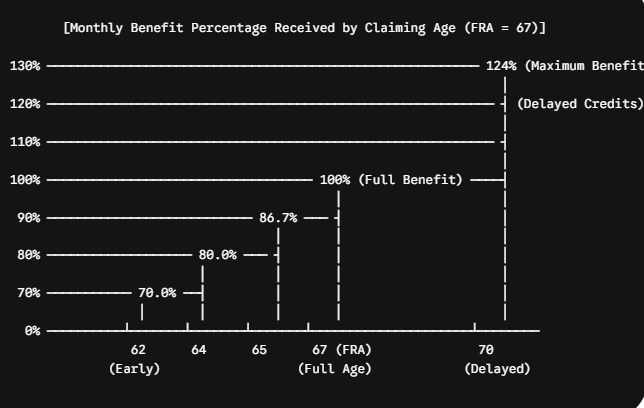
Early Retirement Reduction Chart by Claiming Age (FRA 67)
If your Full Retirement Age is 67 — which applies to everyone born in 1960 or later — here is exactly what percentage of your full benefit you'd receive at each claiming age:
| Claiming Age | Months Before FRA | Benefit Reduction | % of Full Benefit Received |
|---|---|---|---|
| 62 | 60 | -30.0% | 70.0% |
| 63 | 48 | -25.0% | 75.0% |
| 64 | 36 | -20.0% | 80.0% |
| 65 | 24 | -13.3% | 86.7% |
| 66 | 12 | -6.7% | 93.3% |
| 67 (FRA) | 0 | 0% | 100.0% |
Source: Social Security Administration – Benefits Planner for Those Born in 1960 or Later
Want to see your own numbers instead of the average example above? Run your actual earnings history through our Benefits Estimator to get a personalized projection at every claiming age.
A Real Dollar Example: $2,000 Full Benefit
Numbers are easier to grasp in dollars than percentages. Suppose your PIA at FRA (67) is $2,000 per month:
- Claim at 62: You receive $1,400/month — a loss of $600/month, or $7,200/year, for life.
- Claim at 67 (FRA): You receive the full $2,000/month.
- Claim at 70: You receive $2,480/month, thanks to delayed retirement credits of 8% per year between FRA and 70.
Source: Social Security Administration – Delayed Retirement Credits
Over a 20-year retirement, the gap between claiming at 62 and waiting until 70 can exceed $250,000 in cumulative payments — before accounting for COLA compounding. To see exactly when the higher monthly checks from waiting catch up to and overtake the head start from claiming early, try our Break-Even Calculator.
Is the Penalty Ever Reversed?
No — the reduction is permanent once you start receiving retirement benefits, and it does not reset when you reach FRA. The only partial exception involves the Retirement Earnings Test: if you claim early and continue working above the annual earnings limit, the SSA temporarily withholds benefits, but later recalculates your monthly amount at FRA to credit back the withheld months. This raises your check slightly, but it does not erase the underlying early-claiming reduction itself.
Source: Social Security Administration – Receiving Benefits While Working
"If you start receiving benefits early, your benefits will be reduced a small percentage for each month before your full retirement age." — Social Security Administration
Source: Social Security Administration – Retirement Age and Benefit Reduction
Does the Penalty Apply to Spousal Benefits Too?
Yes, and the reduction schedule is steeper. A spousal benefit claimed at 62 (with an FRA of 67) can be reduced by up to 35%, compared to the 30% maximum reduction on your own retirement benefit. The formula uses a different monthly rate: 25/36 of 1% for the first 36 months, then 5/12 of 1% for additional months.
Source: Social Security Administration – Spouse's Benefit Calculator
Frequently Asked Questions
How much do I lose if I claim Social Security at 62 instead of 67?
You lose 30% of your Primary Insurance Amount permanently if your Full Retirement Age is 67. For a $2,000 full benefit, that means receiving $1,400 per month instead — a $600 monthly, or $7,200 annual reduction for life.
Source: SSA.gov
Does the early retirement penalty ever go away?
No. The reduction is locked in for life once you begin collecting retirement benefits. It does not increase back to 100% when you reach full retirement age; it only rises modestly over time through annual COLA increases.
Source: SSA.gov
What's the break-even age for claiming Social Security early?
Most break-even calculations land between ages 78 and 82, depending on your exact benefit amounts and claiming ages compared. If you expect to live beyond that range, delaying typically results in more lifetime income.
Can I undo my decision if I claimed at 62 and regret it?
You have a one-time option to withdraw your application within 12 months of filing, but you must repay all benefits received. After that window, or after 12 months have passed, the only way to increase your monthly amount is to suspend benefits at FRA and let delayed retirement credits accrue until age 70.
Source: Social Security Administration – Withdrawing Your Application